

This story originally ran in the November 7, 2008 issue of The Guide.
BY JAY STRUTH
When 88-year-old Keith Watts of Killarney joined the army in Brandon in 1941, the last thing he thought he’d be doing was touring Europe with a band. Like most young men he was anxious to get overseas and fight for his country, but the army had other plans for him.
“When I joined the army in Brandon at the Artillery Training Centre they asked what I could do, and well, I could play the trumpet,” said Watts. “I had played trumpet in the town band in Cartwright where I grew up, starting when I was about 14. Then they asked if I could play the bugle, and I told them I had never tried but perhaps I could.”
The Brandon Artillery Training Centre was in the midst of forming a military band and they needed a bugle player. Watts seemed like a good fit, so they put him on the bugle and formed a band. He played with the military band in Brandon for about a year.
“We played all the time,” remembered Watts. “We marched around town, played church parades, we played for funerals, and plenty of other functions. But I was anxious to get overseas.”
Watts finally got his wish and was shipped out to England on the Queen Elizabeth, the largest passenger liner ever built at the time.
“The Queen Elizabeth was the biggest ship floating in those days, and that ship was fast,” said Watts. “I remember they zigzagged all the time to avoid enemy submarines, and they figured they were safer going alone with the speed it could go. Most of the ships travelled in convoy then.”
In England Watts began training with artillery again as an artillery gunner, until one day three names were called out, and his was one of them.
“They said ‘pack your gear and hit the orderly room,’” he recalled. “They packed us up, and we found out after that they were forming bands in the UK. It ended up there were nine Canadian bands formed, with 28 people per band. I ended up in the artillery band. You don’t get much choice as to what you want to do.”
Watts became a member of the Royal Canadian Artillery Band. They played to people at Buckingham Palace and Windsor Castle and their music was broadcast on the B.B.C. radio. They played a variety of different events and venues, mostly in and around the London area at first.
“We would go to London to broadcast or to parade a regiment say to Westminster Abbey or Windsor Castle,” said Watts. “We never knew where we were going. We might take our blankets and stay a day or two somewhere but usually we’d end up coming back.”
Twelve of the members of the 28 piece military band, including Watts, also played in a dance orchestra. The 12-piece dance band played the popular jazz and swing dance numbers of the time.
“The wife of one of the players sent over the latest dance tunes that were on the go in Canada and the U.S.,” said Watts. “We played dances and we played on the B.B.C. too.”
One of the best-selling recording artists of the time, leading one of the best-known big bands of the era, was Glenn Miller. Watts was able to see his orchestra live just before Miller’s plane disappeared in bad weather on his way to entertain U.S. troops in France.
“When we were in London they were playing at the Queensbury Club, when they broadcast out of there, and we used to line up on three sides of a building, about four or five deep, to get in to see these guys – these big name guys,” remembered Watts. “Poor Miller, he went off to somewhere in a plane and disappeared.”
Keeping up the morale of not only the troops, but of the workers who kept the war effort going, was also a big thing. Watts had the pleasure of playing in a large gun factory and other unusual venues for the workers in London.
“It was a morale thing,” he explained. “One thing about the British, and the Europeans in general, is they liked bands. They liked military band stuff because they were so used to having them around, where in Canada we didn’t have that. The Canadians weren’t as interested in hearing us as say the British troops would be, or the civilians, because they were more used to American music. That’s where our dance band came in – because they liked that kind of stuff.”
Watts’ dance band also did some broadcasting on the B.B.C. and enjoyed the in-studio experience.
“The groups would go into a studio and they would record it, all because they wanted to make sure there wasn’t any bomb noise on the tracks,” he said. “London was being bombed at the time.”
In the summer of 1944 the buzz bombs began to fall on London, and Watts remembers the havoc they wreaked.
“A buzz bomb was an airplane without a pilot that the Germans launched from France,” he explained. “They had enough fuel to get to London, and a built in 1,000 pound bomb which, exploded when the plane crashed. Dozens of them came over every day and they did a lot of damage and killed a lot of people.”
In September of 1944 the Canadian bands were shipped to Italy where two divisions of Canadians were fighting with the British 8th Army there.
“We spent the winter there in the mud and snow, and we would go up near the front and entertain the troops,” he said. “At one place there was a mobile bath set up so the troops could have a shower and get a change of clothes. Our dance orchestra played in a building nearby when we didn’t have something else scheduled. The troops could get a coffee and relax for an hour or two and listen to the music. We also played for memorial services. When a regiment came out of the line for a rest, we would often play for a memorial service for those who had been killed.”
The spring of 1945 came, and all the Canadians in Italy were moved to Western Europe. They went by ship to southern France, then by truck to Belgium and Holland.
“One day we were sent to play for an artillery regiment, and when we got there they were firing on the enemy, but we played for them anyway,” he said. “They would fire a few rounds, wait 15 minutes, and fire a few more.”
Watts said all of the band members had rifles as well, which turned out to be a real nuisance for them.
“We had them in case the Germans put a push on you. You’re not going to do much if you haven’t got some kind of a weapon,” he said.
When the bands arrived in Belgium they were given Browning 9 mm pistols, so they could carry their weapons on their belts.
“At least you didn’t have these rifles hanging over your shoulder anymore,” he said. “It wasn’t too bad for me with a trumpet, but with bass players it was a little different story.”
The Royal Canadian Artillery Band was in Germany when the war ended, and for a while they were back and forth between Holland and Germany. Watts said on two different occasions German ammunition dumps blew up near them, and one of the scares left him with a memento.
“None of us were hurt, but a piece of shrapnel hit my boot,” he said. “I picked it up and it burned my fingers. When it cooled I put it in my pocket, and I still have it.”
After the war many of the bands continued to play for several months, at large parades and celebrations and even garden parties for the officers.
“There was more spit and polish after the war than there was when it was going,” said Watts. “We eventually went back to Britain as the troops were going home. And we did the same thing in Britain again, playing here and there. I was there for seven months after the war ended before I got home.”
Watts came back to Canada in March of 1946, settling back in Cartwright, where he eventually became postmaster like his father before him. He met his wife Rita, who was a school teacher in Cartwright, shortly after he got home. In 1948 they were married, and had four children, the youngest of which, Michelle Johnson, lives in Killarney with her family. Keith and Rita moved into the Royal Legion Plaza in Killarney almost 11 years ago.
“I kept in touch with the band member whose wife used to send us sheet music up until a couple of years ago when he passed away,” said Watts. “He kept playing in bands the rest of his life.”
In closing, Watts recalled one of the most special moments he shared with band mates during the war.
“We were sent out one morning by truck to a big estate that the Canadians had taken over for their Second Division headquarters,” he explained. “We didn’t know why we were sent of course, but we got there and this guy said: ‘the King’s coming. He’s coming for lunch today. We’ve got an Honour Guard and we’re going to have a rehearsal today at 11 o’clock, and the King’s coming at noon.’
“So we got lined up in the yard there, and these 30 guys with their rifles are lined up, and we’re all ready to have this rehearsal,” he continued. “All of a sudden these two motorcycles came in and the King’s car came in with two motorcycles behind that. The guard commander looked at the bandmaster, gave him a little nod and then the King stepped out of his car and the guard commander yelled: ‘Royal Salute Present Arms,’ and then we played God Save the King. No chance for a rehearsal, but it went off as if it had been well rehearsed.”
Shortly after the King had gone inside, two Canadian generals pulled up and saw the car.
“Is that the King’s car? Is the King here already?” they asked.
“I think they expected to be there before the King,” laughed Watts.
The band had the honour of playing chamber music for the King while he ate, and it’s a memory that’s still vivid for Watts.
“I’ve often thought if it had been the president of the United States there would have been about two miles of security, and there he was with a couple of motorcycles ahead of him.”
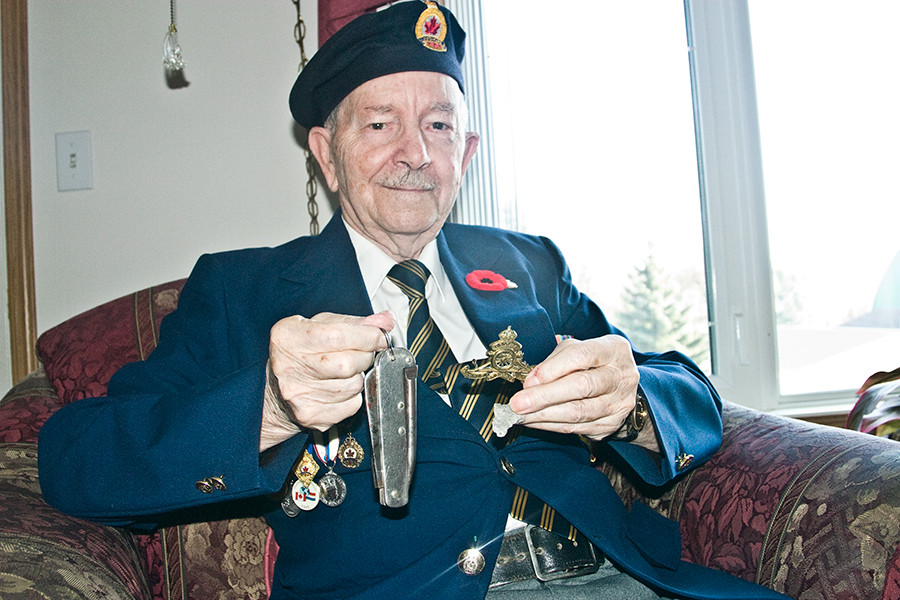
A MAN WHO PLAYED FOR THE KING – Keith Watts sits in his Royal Legion Plaza apartment displaying his old military issue knife, his Royal Canadian Artillery pin, and a piece of shrapnel from an ammunition dump that exploded and hit his boot during World War II.
JAY STRUTH/KILLARNEY GUIDE
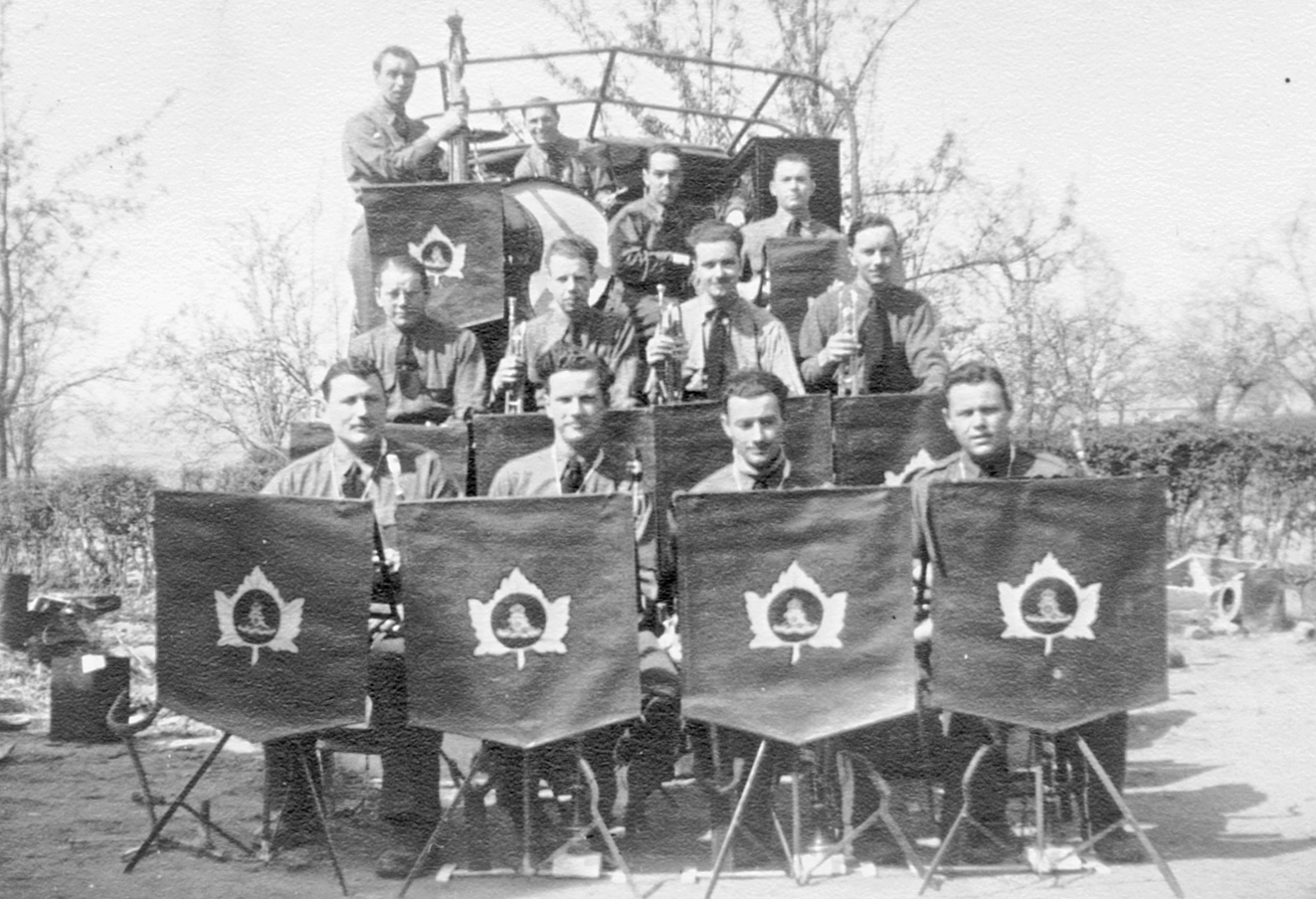
BANDS WERE BIG – Keith Watts, in the middle row on the far right, poses for a picture with his dance band, set up on the back of a military truck, as they often played.